SobellLogo3
  • News
  • Instruments
    • 40th Anniversary Model Guitars
    • Flat Top Guitars
      • Steinbeck Model Guitar
      • Martin Simpson Signature Model
      • New World Guitar
      • Model 4 Dreadnought
      • D Guitar
      • Verona Guitar
    • Arch Top Guitars
      • 6 String Arch-Top guitar
      • Twelve string Arch-top
    • Citterns and octave mandolins
    • Mandolins & Mandola
  • Construction and Design
    • Wood
  • Available now
  • About Us
    • Contact
    • How I started: my first cittern
  • Things they say
  • Order
  • Tonewood for sale
    • Indian rosewood for sale
    • Brazilian rosewood for sale
30 Aug2013

Long neck mandolin project part 4

Completing the body

With the back and sides fully prepared, I now had to fit the soundboard. This was rough carved, then final thicknessed, sanded and braced so as to be ready to be glued onto the sides. But before gluing, it sat on the warm shelf for at least a week so as to settle into its final shape.

As before, I wanted any movement to take place before fitting so as to avoid internal tension as far as possible.
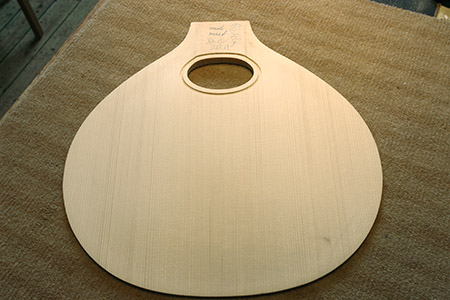
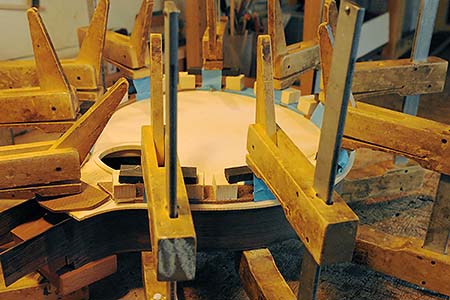
Before fitting the top, I first checked the fit of the top with the sides (which already had the top lining glued in place). Anywhere the fit wasn’t perfect was trimmed until it was.

This tends to involve going round and round, improving one area while making others just a little worse. But eventually the fit is perfect.

Then I spread the glue around the lining and top of the sides and clamp the soundboard in place.

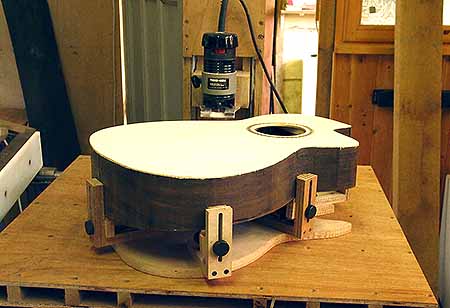
To take the bindings and purflings, I routed L shaped ledges around the top and bottom of the body using a laminate trimmer and different bearings to give the different width cuts needed. I didn’t photograph this procedure, but here is a picture of a guitar ready for routing.

It is clamped in a flat bottomed cradle to keep it level, and moved around the stationary cutter. The cutter can move up and down to accommodate variations in height, but the width of the cut is fixed and determined by whichever bearing is attached to the cutter.

This has to be repeated with a different size bearing for each different width ledge, i.e. once for the binding ledge and again for the purfling ledge.
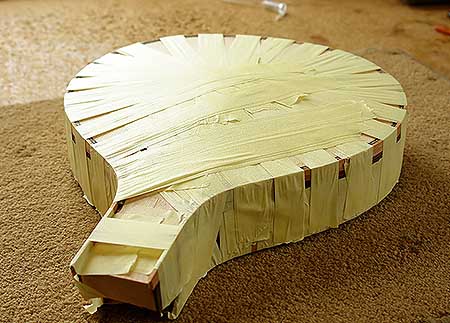
I next bent the Cuban mahogany binding, the red/green/gold back purfling and the Birdsfoot soundboard trim to shape on the hot pipe bender, and trimmed the ends to mitre in with the purfling down the centre of the back and where the sides meet.

I ran glue around the routed ledges, fitted the purfling and bindings in place, and then taped them tightly. After all these years taping binding still seems a primitive system, but it works well and my attempts to devise an effective alternative have not worked out.

Part of the problem is the stiffness of wooden binding, as it requires a stronger pull to make sure it is properly in place than does more flexible plastic binding.[/one_half_last]
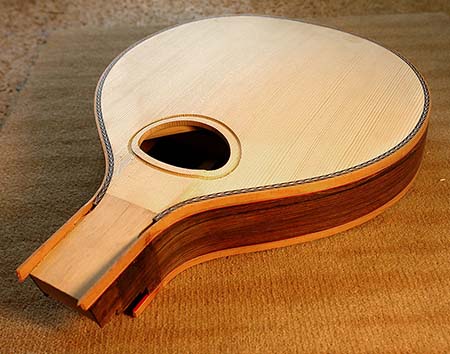
[one_half]When the glue had thoroughly dried I (carefully) removed the tape before scraping down any proud binding and purfling. I then sealed this and sanded it clean.

Now the body is ready to receive the rosette, and then the neck and fingerboard.
25 Aug2013

Long neck mandolin project

Patrick de Broux is a generous man. He was unable to attend either of my talks in aid of Whitley Chapel Village hall (see item below) but on both occasions made a £50 donation.
I announced this to the audience, and after they had applauded his generosity, pointed out that Patrick perhaps knew something they didn’t; after all, he’d paid several times the ticket price NOT to come and hear me.

Patrick recently came to me with an interesting project. He asked me to build a Cuban Tres, a small guitar bodied instrument with three pairs of strings. This instrument is a long term project and is still under construction.

He also asked me to build a small bodied mandolin with an extended neck, tuned two and a half tones lower than standard. This would tune DAEB, but a capo on the fifth fret would give mandolin tuning and scale.
This project also really interests me, and I’m now well on with it. Andy Irvine played an extended neck mandolin of mine (but with two extra frets rather than five) for many years, and Patrick had this in mind when thinking of his mandolin.

Andy

Here is Andy (centre) with his small bodied long scale mandolin, pictured with his band Mozaik. On the right is Rens van der Zalm with his standard scale large bodied version.
I would have made the back and sides from the Birds-eye maple I love so much, but Patrick asked about my scantling Brazilian rosewood. I found a pretty and very resonant piece just wide enough to make mandolin sides (without having to join two pieces together to get the width, as on scantling guitars).
This scantling would cut into enough pieces to make not just the sides, but also a multi-piece back; it’s nice to have back and sides from the same piece. I later found there was enough left over to make the headstock veneer from it as well.

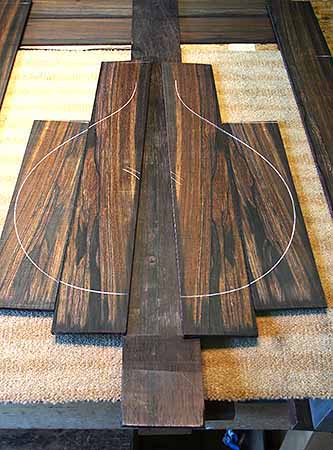
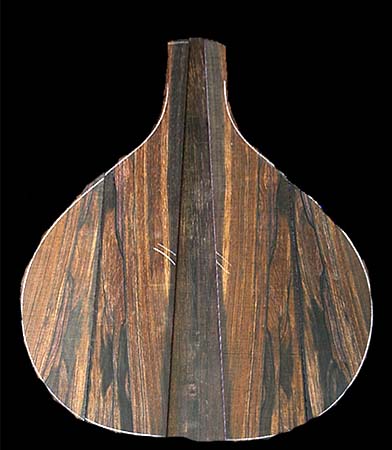
In the end I felt the back looked best with a dark strip from another scantling down the centre, between two strips from the original scantling on either side. This would have meant the back having four joins, with two purfling strips, one on either side of the dark centre strip.

The two photos below show the strips arranged this way, the second with the surround blacked out to give an idea of how the wood looks in mandolin shape.


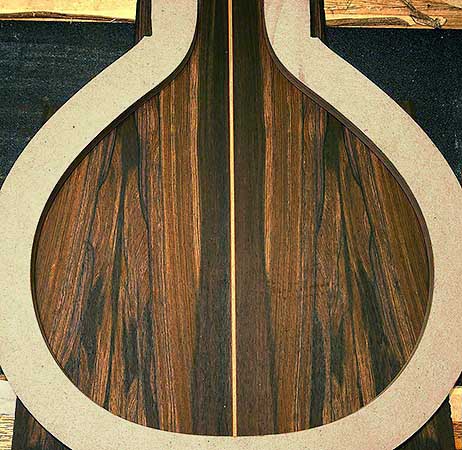
But when I sent Patrick pictures, he suggested cutting the dark piece into two with purfling in between down the centre of the back. The dark centre would then blend with dark areas on either side.

While I wasn’t keen to add an extra unnecessary join just for cosmetic reasons, it wasn’t really important so I eventually agreed. The photo right shows the back joined and sanded to thickness (with the mould resting on it to show the final shape).

Patrick’s idea worked out just as he had wanted, in that the black centre strip (now cut into two) blends perfectly with the black edges of the strips on either side. Lacquering may show up a minor change at the join, but I’m sure it won’t be obvious.

The back now looks to be a two piece back (while in fact being a six piece back) instead of looking like a three piece back (while in fact being a five piece back).

Life can be interesting and complicated; Patrick and his ideas always add interest and usually add complication.

All these joins will require re-inforcing strips on the inside.

04 Mar2007

Bill Flatman

Bill Flatman built my mandolin and cittern cases in the late 1970s and early 1980s. He died unexpectedly on 3rd March. He was just sixty-five years old.

Bill was a farmer who lived and grew up on a hill farm close to Whitley Chapel. When I was looking for fibre-glass cittern and mandolin cases to replace my primitive wooden ones, Bill volunteered and made them in his small garden shed. He had no previous knowledge of fibre-glass but went round the canoe building classes in the North East of England, learning how to lay up fibre-glass and where to find the required components. He rewarded his informants with heather honey combs from his own bee hives. He was an ingenious and enterprising man.  I and many others will miss him greatly.

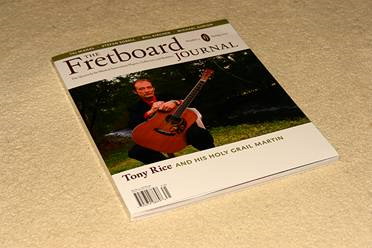
The Fretboard Journal

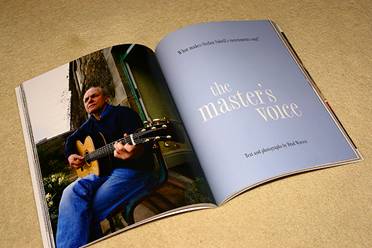
Many people already know of the Fretboard Journal. For those who don’t, it’s a beautifully produced quarterly publication of serious in-depth articles on all subjects concerning fretted instruments.

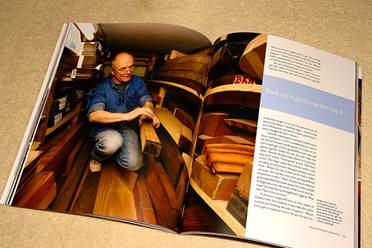
Last summer Brad Warren visited and stayed a few days, talking, asking questions and taking photographs. The picture at the head of my ‘Wood and Materials’ webpage is one of his photographs.

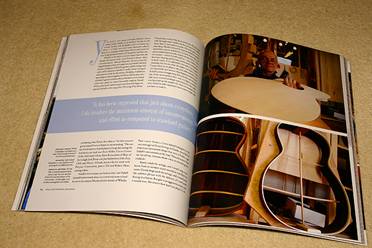
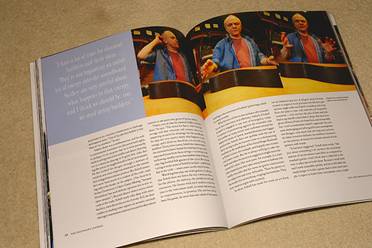
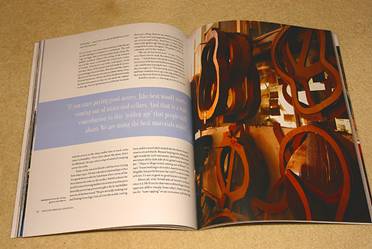
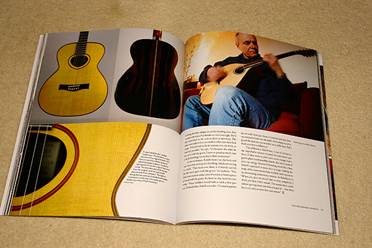
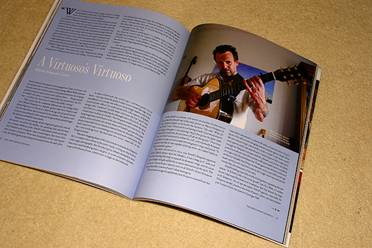
The current issue of the Fretboard Journal includes the article he wrote about me and my instruments. Brad is a good interviewer; his conversation and questions made me think really hard about what I feel and believe is important to instrument building. Brad is also a good writer, his article presents my views well. The article includes an interview he did with Martin Simpson, concentrating on Martin’s use of my guitars and how he views them.


  • 1
  • ...
  • 12
  • 13
  • 14
  • 15

  • News
  • Instruments
    • 40th Anniversary Model Guitars
    • Flat Top Guitars
      • Steinbeck Model Guitar
      • Martin Simpson Signature Model
      • New World Guitar
      • Model 4 Dreadnought
      • D Guitar
      • Verona Guitar
    • Arch Top Guitars
      • 6 String Arch-Top guitar
      • Twelve string Arch-top
    • Citterns and octave mandolins
    • Mandolins & Mandola
  • Construction and Design
    • Wood
  • Available now
  • About Us
    • Contact
    • How I started: my first cittern
  • Things they say
  • Order
  • Tonewood for sale
    • Indian rosewood for sale
    • Brazilian rosewood for sale